Hi everyone,
Just wanted to let you know that my first post is up on the new CARE for AIDS blog at:
http://careforaids.org/blog
I would really appreciate it if you could check it out and leave a comment about the direction you think the blog is heading. We are praying that this blog will be a valuable tool for reaching new audiences and presenting interesting, challenging content, and any feedback is wonderful!
Thanks so much!

Showing posts with label CFA. Show all posts
Showing posts with label CFA. Show all posts
Thursday, August 25, 2011


Wednesday, August 17, 2011
New CARE for AIDS Website and Blog!
As promised, I want to let you all know that CARE for AIDS has a completely new website live online at www.careforaids.org Please check it out - there are all sorts of interesting video profiles of clients, descriptions of each church that we partner with, and breakdowns of how we do what we do. The website also includes a new blog! From now on, I will be posting periodically on the CARE for AIDS blog. My posts will focus on international development, Christian ministry, and what it's like to run a non-profit from the US.
I would love for all of you to follow this new blog. It will also have periodic posts from our Kenyan directors and each of the other Americans on staff with CARE for AIDS, and I think it will provide some challenging thoughts, no matter where you are in life. Please pray for the launch of this new site and the potential it holds to reach many new people with the work that is happening in Kenya. If you could share the site and the blog with your own friends and networks, I would really appreciate it!
I would love for all of you to follow this new blog. It will also have periodic posts from our Kenyan directors and each of the other Americans on staff with CARE for AIDS, and I think it will provide some challenging thoughts, no matter where you are in life. Please pray for the launch of this new site and the potential it holds to reach many new people with the work that is happening in Kenya. If you could share the site and the blog with your own friends and networks, I would really appreciate it!
Monday, July 11, 2011
These Days
Well, it's been two and a half months since I posted anything on this blog, but I've heard from a few people who requested a little update so I'm going to try and give you just that! I guess the last post wasn't really a "conclusion," but does life really ever have those?
Jane and I got back to the States in the first week of May and entered into a whirlwind summer of transition, families, and lots of big changes. I celebrated my brother Preston's graduation in Nashville and then went on a family trip to Peru for a couple of weeks, before Jane and I reunited in Charlotte during the first week in June. Since then we've bounced around between Atlanta, Charlotte, Nashville,Winston-Salem, the Tennessee mountains (twice), and Cleveland. We've been blessed with wonderful time with each of our families, gotten to celebrate at a good friend's wedding, been a part of a joint family vacation, signed a lease on an apartment, and reunited with many old friends.
We've also had LOTS of wedding conversations and decisions! Right now we are 12 days away from THE day, so most things are planned and we're down to the little details. God has been so faithful to give us many awesome people to help in this whole process and to keep it all from getting out of control. I truly believe that we are both enormously excited about the wedding AND our life that starts together after that, and I thank God for how he has kept us from getting swept up in the craziness. Please pray for us as July 23 gets closer!
I've also had some people ask about what's going on with CARE for AIDS. As soon as we got back to the States, I started transitioning into my new role as Operations Director with CFA. I am our second full-time staff member here in the States, so for the foreseeable future I'll be handling the Operations side of the ministry from Winston-Salem. This will involve keeping tabs on what's happening in Kenya, coordinating textbook drives, working on marketing and back-office projects, planning Cornel and Duncan's trip to the States in October, getting over to Kenya with vision trips occasionally....it's really an unending list! It's exciting, though, and I'm blessed to have the opportunity to take my experiences over the past two years and apply them to the US-side of the ministry. Please feel free to get in touch with me if you have any questions about CARE for AIDS - I'm probably a little closer to you now than I used to be!
I'm not sure if I'll continue posting on this blog. I probably will try to post from time to time - more often than the last few months but not as often as when I was in Kenya. We are also trying to start a true CARE for AIDS blog soon, so I will be posting from time to time there. I'll be sure to share that once it is active.
Thanks for your thoughts and prayers!
Jane and I got back to the States in the first week of May and entered into a whirlwind summer of transition, families, and lots of big changes. I celebrated my brother Preston's graduation in Nashville and then went on a family trip to Peru for a couple of weeks, before Jane and I reunited in Charlotte during the first week in June. Since then we've bounced around between Atlanta, Charlotte, Nashville,Winston-Salem, the Tennessee mountains (twice), and Cleveland. We've been blessed with wonderful time with each of our families, gotten to celebrate at a good friend's wedding, been a part of a joint family vacation, signed a lease on an apartment, and reunited with many old friends.
We've also had LOTS of wedding conversations and decisions! Right now we are 12 days away from THE day, so most things are planned and we're down to the little details. God has been so faithful to give us many awesome people to help in this whole process and to keep it all from getting out of control. I truly believe that we are both enormously excited about the wedding AND our life that starts together after that, and I thank God for how he has kept us from getting swept up in the craziness. Please pray for us as July 23 gets closer!
I've also had some people ask about what's going on with CARE for AIDS. As soon as we got back to the States, I started transitioning into my new role as Operations Director with CFA. I am our second full-time staff member here in the States, so for the foreseeable future I'll be handling the Operations side of the ministry from Winston-Salem. This will involve keeping tabs on what's happening in Kenya, coordinating textbook drives, working on marketing and back-office projects, planning Cornel and Duncan's trip to the States in October, getting over to Kenya with vision trips occasionally....it's really an unending list! It's exciting, though, and I'm blessed to have the opportunity to take my experiences over the past two years and apply them to the US-side of the ministry. Please feel free to get in touch with me if you have any questions about CARE for AIDS - I'm probably a little closer to you now than I used to be!
I'm not sure if I'll continue posting on this blog. I probably will try to post from time to time - more often than the last few months but not as often as when I was in Kenya. We are also trying to start a true CARE for AIDS blog soon, so I will be posting from time to time there. I'll be sure to share that once it is active.
Thanks for your thoughts and prayers!
Thursday, April 21, 2011
Adoption vs. Life Sustained
I'm currently reading a book given to me by my Aunt called there is no me without you by Melissa Faye Greene. I can't give a full review or recommendation on the book yet (I'm only four chapters in), but I wanted to share an excerpt from early on in the book that hits at the heart of the perspective of CARE for AIDS on a role as an orphan preventer and not an orphan caretaker:
"Adoption is not the answer to HIV/AIDS in Africa. Adoption rescues few. Adoption illuminates by example: these few once-loved children -- who lost parents to preventable diseases -- have been offered a second chance at family life in foreign countries; like young ambassadors, they instruct us. ...
'Adoption is a last resort,' I would be told in November 2005 by Haddush Halefom, head of the Children's Commission under Ethiopia's Ministry of Labor, the arbiter of intercountry adoptions...'I am deeply respectful of the families who care for our children,' he said. 'But I am so very interested in any help that can be given to us to keep the children's first parents alive. Adoption is good, but children, naturally, would prefer not to see their parents die.'"
People often ask us what we are doing for the orphan victims of the HIV/AIDS crisis in Africa. Sometimes its hard to answer, basically, that we aren't doing anything for the existing orphans. Thankfully, there are many other organizations, churches, and individuals raising money and reaching out to take care of orphans. Our focus is on the less apparent side - taking care of HIV-positive parents and enabling them to live 20 or 25 years to raise their children themselves. Right now there are about 800 current CARE for AIDS clients, representing at least 2,500 children. Two thousand five hundred children who won't have to experience what it's like to be an orphan.

"Adoption is not the answer to HIV/AIDS in Africa. Adoption rescues few. Adoption illuminates by example: these few once-loved children -- who lost parents to preventable diseases -- have been offered a second chance at family life in foreign countries; like young ambassadors, they instruct us. ...
'Adoption is a last resort,' I would be told in November 2005 by Haddush Halefom, head of the Children's Commission under Ethiopia's Ministry of Labor, the arbiter of intercountry adoptions...'I am deeply respectful of the families who care for our children,' he said. 'But I am so very interested in any help that can be given to us to keep the children's first parents alive. Adoption is good, but children, naturally, would prefer not to see their parents die.'"
People often ask us what we are doing for the orphan victims of the HIV/AIDS crisis in Africa. Sometimes its hard to answer, basically, that we aren't doing anything for the existing orphans. Thankfully, there are many other organizations, churches, and individuals raising money and reaching out to take care of orphans. Our focus is on the less apparent side - taking care of HIV-positive parents and enabling them to live 20 or 25 years to raise their children themselves. Right now there are about 800 current CARE for AIDS clients, representing at least 2,500 children. Two thousand five hundred children who won't have to experience what it's like to be an orphan.

Tuesday, April 19, 2011
Knowledge Multiplication
I'm an engineer (technically), which makes me, by default, a big fan of math and machines. While my current job doesn't involve too many machines of the mechanical kind - except when my car falls apart - it does involve the creation of mechanisms that attempt to maximize the effectiveness of the resources that CARE for AIDS has at its disposal. I love the idea of an exponential curve applied to growth of any kind, essentially a process where something multiplies then multiplies again and again and again...and never stops. This shows up in all kinds of ways through CFA. For example, if we can help one mother live an extra 20 years, she can keep 4 kids from becoming orphans...then each of those 4 kids can grow up empowered to give THEIR 4 kids a better life...and so it goes.
Another way this idea of exponential growth shows up is in the proliferation of knowledge. Last year, the Central Baptist center in Kisumu held a seminar hosted by an outside facilitator in which clients were taught how to use cheap or free materials to make baskets, which they can sell for people to use when shopping, carrying products to market, storing items in their homes, etc. One client, Mary Ochieng, took this skill and ran with it. She collected construction waste like the wrapping on bundles of materials and created baskets that sold well and provided a much-needed income. The workers at Central told the workers at a different CFA center in Nyalenda Baptist Church about Mary, and last week she visited the current group of clients at Nyalenda to pass on the basket-making skills that she learned last year. Not only is this a great encouragement to the new clients - they get to learn from someone who was in the EXACT same position that they are - it's an empowering experience for Mary. She gets a little extra income from spending a day teaching, but she also receives the confidence and hope that come from realizing that you have something to offer and knowing that you have helped other people.
Now the simple skill of basket-making has "jumped" from one community to another, and the training of one client at Central has multiplied to a whole group of clients at Nyalenda. That's engineering I can get excited about...
Another way this idea of exponential growth shows up is in the proliferation of knowledge. Last year, the Central Baptist center in Kisumu held a seminar hosted by an outside facilitator in which clients were taught how to use cheap or free materials to make baskets, which they can sell for people to use when shopping, carrying products to market, storing items in their homes, etc. One client, Mary Ochieng, took this skill and ran with it. She collected construction waste like the wrapping on bundles of materials and created baskets that sold well and provided a much-needed income. The workers at Central told the workers at a different CFA center in Nyalenda Baptist Church about Mary, and last week she visited the current group of clients at Nyalenda to pass on the basket-making skills that she learned last year. Not only is this a great encouragement to the new clients - they get to learn from someone who was in the EXACT same position that they are - it's an empowering experience for Mary. She gets a little extra income from spending a day teaching, but she also receives the confidence and hope that come from realizing that you have something to offer and knowing that you have helped other people.
Now the simple skill of basket-making has "jumped" from one community to another, and the training of one client at Central has multiplied to a whole group of clients at Nyalenda. That's engineering I can get excited about...
 |
| Mary teaches basket-weaving at a Nyalenda seminar |
Tuesday, March 8, 2011
Spiritual Growth
 One of the big challenges that faced me as I began this role with CARE for AIDS was the need to standardize the services that we offer to all of our clients in different centers across the board. Spiritual counseling was an especially tricky subject - how could we make sure that each of our individual spiritual counselors would offer the same kind and quality of spiritual teaching and encouragement to the clients? At least part of an answer to this problem has arrived in the form of a partnership with the Kenya Bible League. Over the past six months, each of our centers has met with their local Bible League office and worked out a plan for all of the clients to receive a workbook called "Steps to Victory" when they enter the CARE for AIDS program. The spiritual counselors help them form into small groups of about 5 clients, and during the week they meet together to read through the fundamental aspects of a Christian faith and answer questions based on scripture references in the workbook. Then, they meet together with the spiritual counselor to check their answers and review what they've learned.
After completing the Steps to Victory workbook, the groups are given a second workbook titled "Bearing Fruit," which focuses on how to live out a Christian life and share the gospel with other people. When they successfully complete this book with good grades, they are awarded a certificate and a Bible written in Swahili, English, or their local language. This process is producing great results with the clients. They really enjoy the challenge of the workbooks, meeting together in a group, and reviewing their answers each way. This method allows us to ensure that each client has a foundational understanding of scripture before we hand them a Bible, and this fact combined with the personal time investment that they put in means that they will value and use the Bible more than they might otherwise. Kenyans also LOVE certificates, so that aspect definitely can't be overlooked!

Wednesday, February 23, 2011
CFA Email Updates
One part of my job that has developed quite a bit over the past six months consists of updating donors on the progress of the CFA centers that they support. Our goal is to send out email updates every three months or so, which means that (at this point) I put together two or three updates each month. It's an interesting opportunity to apply some of my "artistic" side, in addition to being a great chance to investigate the great things that are happening in each center. I usually interview the workers to get some quotes and statistics, scour the monthly reports for stories, take some pictures or commission them from the regional coordinators, and then try to combine all of these things into an encouraging and aesthetically-pleasing format. Here's a recent update that describes the graduation of the first group of clients from the Gachie center - praise God for the great things He is doing!
Gachie Graduation Update
Gachie Graduation Update
Thursday, February 17, 2011
Numbers vs. Change
I ran across a really interesting article from the Harvard Business Review about, among other things, the criteria that people look for in choosing which organizations in the humanitarian sector warrant their charitable contributions. It seems to be an overriding trend that the average American is much more interested in a low overhead percentage than in actual, demonstrated results from a non-profit. In one study cited in the article, 79% of respondents reported that they wouldn't give money to a cause without knowing how much goes to overhead/administration, while only 6% said they needed to know if their money was going to make a difference.
 That's REALLY frustrating for me! As one of the people working in the humanitarian/non-profit/whatever sector, I've experienced firsthand the intrinsic difficulties caused by an obsessive focus on showing off a pie chart with a little tiny sliver labeled "administration" and the rest proudly marked "project costs" or something like that. The problem is that this system doesn't reflect the positive change that is resulting from an organization's work. I've seen many groups that are just giving away things to people in need...helping them for a day but hurting them for the rest of their lives and creating absolutely zero long-term benefit for the individuals, their families, or their societies. Many times this even creates a negative overall impact by cultivating an attitude of dependence, hampering local businesses, and stifling the development of skills. BUT it looks great in a pie chart.
If you don't pay anyone to teach people or monitor their progress, you can get a lot of volunteers to hand out things and make themselves feel good. If you don't put any effort or spending into researching needs and evaluating results, then all of your money can go into whatever short-lived "thing" you decide from the other side of the ocean to throw at people. If you don't hire locals as real employees and give them the benefits they deserve, then you won't have much admin cost. You'll have an awesome pie chart and you'll probably get a lot of money thrown at you from innocent Americans, but you won't be doing any good.
It's a struggle for me to see organizations doing this while we try to run CARE for AIDS with an ultimate goal of producing actual change. This means that we do buy computers to track the progress of our clients and analyze our results. It means that we do give our employees benefits like social security, health insurance, and ongoing training seminars to make them effective in their jobs and equip them for the rest of their lives. It means that we spend money on professional teachers and trainers to help our clients learn skills, not only collect handouts. It even means that we pay for quality marketing materials and professional financial advising in the States, because we view them as a long-term investment in our ability to reach more people here in Africa. All of this adds up to more than just a sliver on our pie chart, but it contributes to the real, sustained, long-term change that is taking place in the lives of the clients we serve, the futures of the Kenyans we employ, the health of the churches we partner with, and the reality of the AIDS crisis all across Kenya.
ps - here is the article mentioned

 That's REALLY frustrating for me! As one of the people working in the humanitarian/non-profit/whatever sector, I've experienced firsthand the intrinsic difficulties caused by an obsessive focus on showing off a pie chart with a little tiny sliver labeled "administration" and the rest proudly marked "project costs" or something like that. The problem is that this system doesn't reflect the positive change that is resulting from an organization's work. I've seen many groups that are just giving away things to people in need...helping them for a day but hurting them for the rest of their lives and creating absolutely zero long-term benefit for the individuals, their families, or their societies. Many times this even creates a negative overall impact by cultivating an attitude of dependence, hampering local businesses, and stifling the development of skills. BUT it looks great in a pie chart.
 If you don't pay anyone to teach people or monitor their progress, you can get a lot of volunteers to hand out things and make themselves feel good. If you don't put any effort or spending into researching needs and evaluating results, then all of your money can go into whatever short-lived "thing" you decide from the other side of the ocean to throw at people. If you don't hire locals as real employees and give them the benefits they deserve, then you won't have much admin cost. You'll have an awesome pie chart and you'll probably get a lot of money thrown at you from innocent Americans, but you won't be doing any good.
It's a struggle for me to see organizations doing this while we try to run CARE for AIDS with an ultimate goal of producing actual change. This means that we do buy computers to track the progress of our clients and analyze our results. It means that we do give our employees benefits like social security, health insurance, and ongoing training seminars to make them effective in their jobs and equip them for the rest of their lives. It means that we spend money on professional teachers and trainers to help our clients learn skills, not only collect handouts. It even means that we pay for quality marketing materials and professional financial advising in the States, because we view them as a long-term investment in our ability to reach more people here in Africa. All of this adds up to more than just a sliver on our pie chart, but it contributes to the real, sustained, long-term change that is taking place in the lives of the clients we serve, the futures of the Kenyans we employ, the health of the churches we partner with, and the reality of the AIDS crisis all across Kenya.
And I'm much more proud of THAT than a pie chart.

Ongoing one-on-one training and counseling means more
spending on salaries/benefits and less spending on handouts,
but it actually makes a difference!
Friday, January 28, 2011
New Centers in Thika
Yesterday I drove with Duncan to check out the newest CARE for AIDS region in the Thika area, on the North side of Nairobi. We picked up Kevin, the regional coordinator, and headed out to the Kia-ndutu slum, where the first center is located. Kia-ndutu is a crazy place - one of the more hectic slums that I've been around. Narrow, dirt paths snake their way between ramshackle wood or tin dwellings, and it was a driving test for me to maneuver the car all the way to the Full Gospel Church in the center of the slum.
It's also (apparently), one of the most dangerous places around. The spiritual counselor at the center, Patrick, grew up in Kia-ndutu, so people know him and he is comfortable there. All of the other staff members from Thika refuse to walk through Kia-ndutu unless they are in a group or with Patrick, though, even during the day. As I spoke with Patrick, he told me that during the previous day at about 1pm, he looked out the church window and saw a man get stabbed and robbed...yikes!
That means that there is a LOT of need in the area, and thankfully Patrick and his fellow worker Louise are hard at work meeting with clients and helping them to turn their lives around. We hung out with about 15 clients in the waiting area of the church yesterday and watched as Patrick and Louise counseled them. Only two months into the program, they are already seeing some wonderful developments and learning a lot about the real needs of HIV-positive people in this area.

We then drove to the opposite side of Thika and met with the pastor and center workers for the second Thika center in an area called Kiganjo. We visited the Deliverance Church of Kiganjo, where everyone is excited to host Duncan as a guest pastor this coming Sunday when they officially launch the center. The two CFA counselors, Ann and Patrick, spent some time staying at the house a couple of weeks ago training, so it was great to see them again and share in their excitement to begin working. They have already been visiting support groups and local clinics, and they are well on their way to recruiting a full group of clients for the brand new center.
Please join with me in praying for both of these young CARE for AIDS center. Pray that the workers in Kia-ndutu would have wisdom in working with people of extreme poverty, and that they would stay safe in such a difficult environment. Also pray that the church and staff at Kiganjo would be welcoming to just the right clients as they spend time recruiting people and visiting their homes. Finally, pray for Kevin as he manages both of these new centers and works out logistics in a new area, all while getting used to living in a new place. Thank you so much for your continued prayers - God is truly working miracles in the lives of people with nowhere else to turn, and we praise Him for it!

 | |
| Good ol Prado - still goin strong with 214,000 km! |
 |
| Kia-ndutu slum...not the nicest place to live |
 |
| Patrick talking with a client at Full Gospel Church of Kia-ndutu |
That means that there is a LOT of need in the area, and thankfully Patrick and his fellow worker Louise are hard at work meeting with clients and helping them to turn their lives around. We hung out with about 15 clients in the waiting area of the church yesterday and watched as Patrick and Louise counseled them. Only two months into the program, they are already seeing some wonderful developments and learning a lot about the real needs of HIV-positive people in this area.
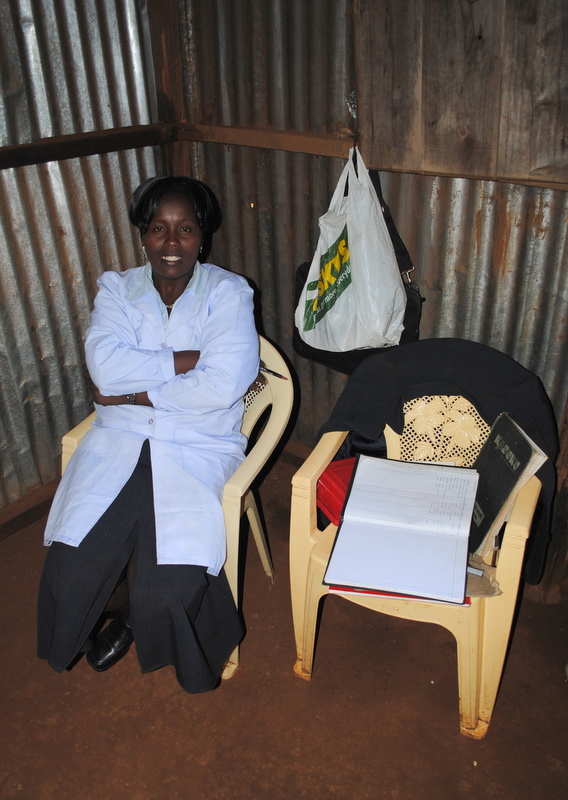
 |
| Pastor Newton, Patrick, and Ann |

Monday, January 17, 2011
Goals for 2011
One of the things that makes me happiest in the course of my job is when I see the members of our Kenyan staff growing and developing as leaders and as reliable, innovative workers. A test of this growth always occurs when I'm gone for a little while. Last year at Christmas, I left a list of things that needed to get accomplished before the end of the year, and when I returned in January, very few of them had been completed to the specifications I'd expected. Over the course of the year since then, though, our whole team in Kenya has really grown in areas of organization, responsibility, and job definition, so I had high hopes when I left behind a few tasks to be completed over this Christmas.
When I returned last week, I wasn't disappointed. Almost everything that I'd asked for had been done just about perfectly, and there was a stack of papers waiting on my desk for me to review - praise God! It made me proud of our administration - the directors and regional coordinators are all really stepping up these days and allowing CARE for AIDS to grow with stability and consistent quality, and this professionalism trickles all the way down to the way that our center workers relate to clients each day.
One thing that the regional coordinators collected from each center while I was in the States is an annual center report for 2010. As part of this report, the center workers were asked to list some of their goals for 2011. I really liked the answers that we received, so I thought I'd share a selection of the responses with you...
Goals for the clients (from Sarah at the Gachie center):
Please join me in praying that God would work through each of these workers to accomplish all of their goals during the coming year. I am so thankful for the passion that each member of our staff has for transforming the lives of people suffering from HIV/AIDS, and I know that the power of the Gospel has only begun to accomplish the fullness of the work of Christ here in Kenya!
When I returned last week, I wasn't disappointed. Almost everything that I'd asked for had been done just about perfectly, and there was a stack of papers waiting on my desk for me to review - praise God! It made me proud of our administration - the directors and regional coordinators are all really stepping up these days and allowing CARE for AIDS to grow with stability and consistent quality, and this professionalism trickles all the way down to the way that our center workers relate to clients each day.
One thing that the regional coordinators collected from each center while I was in the States is an annual center report for 2010. As part of this report, the center workers were asked to list some of their goals for 2011. I really liked the answers that we received, so I thought I'd share a selection of the responses with you...
Goals for the clients (from Sarah at the Gachie center):
- Spiritually - they would know their God, accept the Lordship of Jesus, and be able to witness to others
- Physically - they would adhere to medication and avoid reinfection
- Economically - they would be empowered with skills and ideas so that they can start an income-generating project and be independent financially
- Socially - help them form support groups that can benefit them financially, and discover their talents and strengths
- Move clients to higher echelons of faith
- Be a role model to clients in matters and faith and Christ-likeness
- Give the best that I can give
We have various goals to achieve in our center during 2011. First and the foremost is to let each and every client know that, despite of having HIV and AIDS, and sometimes being hated by their friends, families, and relatives, God still loves them and there is hope to live and serve Jesus.
The other goal is to make sure that every client has known the Word of God through the proper doctrine of the Bible and gets born again for those who are still in darkness.
The other thing is to empower the clients through the seminars and after nine months, each client will be able to depend on his or her own. Spiritually, every client will not have any stigma, and will be able to stand before people or anyone who will be having the same problem and help him or her to transform that person.
Please join me in praying that God would work through each of these workers to accomplish all of their goals during the coming year. I am so thankful for the passion that each member of our staff has for transforming the lives of people suffering from HIV/AIDS, and I know that the power of the Gospel has only begun to accomplish the fullness of the work of Christ here in Kenya!
Tuesday, December 14, 2010
CFA Staff Retreat 2010
Wow - what a crazy and awesome weekend with all of the CFA Kenya team in Naivasha! Since I don't have a whole lot of time right now (it's 3pm and I'm leaving for America tonight...and I haven't started to pack), I'm just going to throw a few pictures up here and give you a short look into the more interesting parts of the weekend...


This is where we stayed - the Lake Naivasha Panorama Park. It was actually a really cool place, with lots of little cabins built into the side of a big cliff looking over beautiful Lake Naivasha. The big building in the picture is where we had all of our meetings.

The weekend included team-building time with activities led by Cornel and Duncan. I realized why they did this as a job for several years - they are GREAT at it! The games were so much fun, and everyone was laughing and running around together like little kids. In this picture, we are stretching out our hips before the games begin...

After dinner on Friday, the official staff retreat DANCE PARTY began. Kevin had his stereo and laptop all hooked up, and we danced around in a group for about an hour, moving in a circle around the outside of the room in the typical Kenyan way. Then, each of us were called up in the middle of the group to dance by ourselves or with one other person to Kevin's choice of songs - hilarious! They all absolutely LOVED seeing me dance and talked about it for the rest of the weekend...

This is round 1 of the breakfast buffet for Kevin. The buffets for each meal were definitely one of the highlights of the weekend for most of the staff - they ate themselves sick! The food was actually quite good, though, and I was pretty full myself...

On Saturday, Duncan, Cornel, and I gave a presentation about the Vision, Core Values, and Goals of CARE for AIDS. I was a little concerned that the staff would want to stay in "play" mode, but they were super engaged and seemed to take a lot from the morning. We got a lot of great feedback, and I was really blessed to hear many of the center workers talk about how excited they are about their jobs.

The hotel had a pool. It was shaped like Africa. It was full of our staff members and me. AWESOME

The whole group! Each year we are getting bigger - last year we were 13, and this year we are 26! Praise God for all that he is doing with CARE for AIDS.
Friday, December 10, 2010
25+1
I'm off to the annual CARE for AIDS staff retreat. That means 25 hyper Kenyans, one mzungu, lots of buffets, team building games, running around in the grass, and (hopefully) an awesome weekend! We're going to the Lake Naivasha Panorama Park (www.lakenaivashapanoramapark.com), which looks pretty great in the pictures on their website. We'll see if it matches up in real life!
Last year, I was unable to fully take advantage of the highlight of this weekend - the buffets. Recovering from a little water-born parasite, my doctor limited me to eating bananas for half of the trip. While that did let me set a new "bananas eaten in one day" personal best at 13, it didn't make for the most exciting time. Hopefully this year will be an improvement! Look for some good stories and crazy pictures to come...
Last year, I was unable to fully take advantage of the highlight of this weekend - the buffets. Recovering from a little water-born parasite, my doctor limited me to eating bananas for half of the trip. While that did let me set a new "bananas eaten in one day" personal best at 13, it didn't make for the most exciting time. Hopefully this year will be an improvement! Look for some good stories and crazy pictures to come...
Wednesday, December 8, 2010
Salvation from Islam
One of the most exciting things that I have seen through CARE for AIDS during this past month was the salvation of our first Muslim client, Amina Machuma Shebari, in the Kangemi CFA center. David and Esther, the center workers at Kangemi, met Amina soon after they started recruiting the first group of clients for the new center. She was very weak, mostly as a result of taking her medication improperly. It seemed that she lived in a kind of self-denial, where she would refuse to take her ARV's for days at a time and had extremely low self esteem. Her living conditions were poorly cared for, and she existed almost entirely alone. They discovered that her extended family and her faith community had rejected her, and "she felt as if she had no home."
While many of these factors come into play in a majority of our clients, the fact that Amina was a Muslim presented David and Esther, and the rest of the CFA team, with a completely new situation. Esther admits that she was "in great fear of her religion." As in America, many people here in Kenya don't really understand Islam, and violence is strongly associated with Muslims because of stories and reports from neighboring countries like Somalia and Ethiopia. Nevertheless, Amina became part of the client group at Kangemi and began attending center days and seminars at the Full Gospel Church of Kenya - Kangemi. After an introductory service, which included a time of worship and a message from the head pastor, Bishop Chege, Amina confessed to David and Esther that she had finally "found a place she could call home." She was amazed at the love and care she received from the church, and she started to have deeper and more involved conversations with David about the Bible and the gospel message. A few weeks later, she made the decision to accept Christ as her savior.
Only a month into the operation of the center at Kangemi, we are already seeing God do amazing things through the church and the community. In addition to Amina, five other clients have already made first-time decisions to follow Christ. Many more clients, like Amina, have now learned the importance of properly taking their medication and are demonstrating drastically improved health and strength. Over the next eight months, we pray that God will continue to work in all 80 of the clients - spiritually, physically, economically, and socially - transforming their lives in the way that only He can. As we open centers closer to Nairobi and eventually on the eastern side of the city, we will progressively be exposed to more and more Muslim-dominated communities. Please pray that God would use CARE for AIDS as a light in these dark places.
 |
| Esther and Amina |
Only a month into the operation of the center at Kangemi, we are already seeing God do amazing things through the church and the community. In addition to Amina, five other clients have already made first-time decisions to follow Christ. Many more clients, like Amina, have now learned the importance of properly taking their medication and are demonstrating drastically improved health and strength. Over the next eight months, we pray that God will continue to work in all 80 of the clients - spiritually, physically, economically, and socially - transforming their lives in the way that only He can. As we open centers closer to Nairobi and eventually on the eastern side of the city, we will progressively be exposed to more and more Muslim-dominated communities. Please pray that God would use CARE for AIDS as a light in these dark places.
Thursday, December 2, 2010
CARE for AIDS Vision
Since returning to Kenya in July, I've been working through a professional development curriculum with Cornel and Duncan. We are using the "Great Leaders Serve" program, created and used at Chick-fil-A by our own board member Mark Miller. Cornel, Duncan, and I have all been gleaning a mountain of insight through the workbooks, audio messages, and guided study of The Secret (by Ken Blanchard and Mark Miller), and it's been incredibly exciting for me to help these guys think through how they can be better leaders. The curriculum focuses on Christ's model of "servant leadership," an idea that is even more counter-cultural in Kenya than in the States, and Cornel and Duncan have really embraced the concept. They are so excited about putting into practice such a revolutionary idea, and I am already seeing the subjects we talk about manifested in their individual leadership - so cool!
Last week we had a long discussion and brainstorming session about vision - "Seeing and Shaping the Future" of various aspects within CARE for AIDS. I thought the ideas that Cornel and Duncan presented were inspiring and exciting, and maybe they will help you to better understand the picture that these guys have of what CARE for AIDS is and will become. Here is what they came up with:
Our centers will be the most efficient and highest quality caregivers in each of their respective communities.
Our centers will create a culturally acceptable environment through which every HIV-infected man or woman will have the opportunity to receive the gospel and to receive nurturing and care via the hope that comes through Christ.
Our centers will reach every man and women living with HIV/AIDS and living in poverty within their respective communities.
Our centers will educate and inspire church congregations to love people living with HIV/AIDS.
Our staff will be the client and community educators, health providers, and agents of change.
Our staff will all completely understand HIV and its implications for individuals and society.
Our staff will all know how to share the Gospel and provide hope to people living with HIV/AIDS.
Our staff will learn how to responsibly and faithfully manage their lives and families.
Our administration will exemplify a new concept of servant leadership that will permeate from the staff to the partnering church, the clients, and the whole community.
Our administration will make CFA into a first-class NGO that will stand the test of the day in terms of accountability and good stewardship of the resources that God has entrusted to us.
Our administration will always examine the big picture of our calling as believers.
Our administration will continually assist and develop the center workers, always seeking to better and more efficiently serve people living with HIV/AIDS through every CFA center.
Last week we had a long discussion and brainstorming session about vision - "Seeing and Shaping the Future" of various aspects within CARE for AIDS. I thought the ideas that Cornel and Duncan presented were inspiring and exciting, and maybe they will help you to better understand the picture that these guys have of what CARE for AIDS is and will become. Here is what they came up with:
Vision for CARE for AIDS
CARE for AIDS exists to engage American Christians to partner with African churches to transform and empower HIV-infected men and women both physically and spiritually.
Vision for each CARE for AIDS Center
Our centers will be the most efficient and highest quality caregivers in each of their respective communities.
Our centers will create a culturally acceptable environment through which every HIV-infected man or woman will have the opportunity to receive the gospel and to receive nurturing and care via the hope that comes through Christ.
Our centers will reach every man and women living with HIV/AIDS and living in poverty within their respective communities.
Our centers will educate and inspire church congregations to love people living with HIV/AIDS.
Vision for CARE for AIDS Staff
Our staff will be the client and community educators, health providers, and agents of change.
- Educators: They will teach the clients how to improve their health and prevent illnesses
- Health Providers: They will treat common illnesses early, before they become serious
- Agents of Change: They will help the clients and the community members to change their knowledge, attitude, beliefs, and practices so that they all lead healthier, positive lives
Our staff will all completely understand HIV and its implications for individuals and society.
Our staff will all know how to share the Gospel and provide hope to people living with HIV/AIDS.
Our staff will learn how to responsibly and faithfully manage their lives and families.
Vision for CARE for AIDS Administration
Our administration will make CFA into a first-class NGO that will stand the test of the day in terms of accountability and good stewardship of the resources that God has entrusted to us.
Our administration will always examine the big picture of our calling as believers.
Our administration will continually assist and develop the center workers, always seeking to better and more efficiently serve people living with HIV/AIDS through every CFA center.
Wednesday, November 24, 2010
Laban Ochieng
Last week, CARE for AIDS celebrated our first client graduation from Kisumu, our second region that started operating at the beginning of this year. People living in the Nyalenda slum in Kisumu are worse off than most of the clients around Nairobi, and we have experienced difficult challenges but also amazing testimonies over the last nine months while working with a group of 80 clients from Central Baptist Church.
One of the clients who shared his story during the graduation was Laban Ochieng, a longtime resident of the Nyalenda slum in Kisumu. Laban discovered he was HIV-positive several years ago and quickly experienced a drastic decline in his quality of life. As his strength failed, he had to quit his job as a skilled mason. When Lazarus and Elizabeth, the CARE for AIDS center workers, met Laban, he was confined to his bed and unable to work, feed himself, or even walk around. He weighed under a hundred pounds and was not taking medication - simply waiting for his life to be over.
Immediately, the CFA workers began helping Laban to get help from the hospitals and start a regimen of medication. They spent time explaining to him how ARV medication works and how to properly take the drugs, along with providing a food supplement to guard against painful side effects. With this treatment, Laban began to regain his strength and was soon able to move around under his own power. A couple of months later, he resumed his masonry work and starting reaping the benefits of a reliable income.
At the same time, Laban was learning through the CFA center about what HIV means and how it relates to one's standing before God. He was taught for the first time that Jesus loves him despite his HIV status and that he could still live a meaningful life for Christ while looking forward to eternity in heaven. Laban discovered the selfless love of people who follow Christ through Lazarus, Elizabeth, and other members of Central Baptist Church. Several months into the program, he made the decision to commit his life to the Lord! Since April, Laban has been regularly attending services at Central Baptist and becoming more and more a part of the church community.
Today, Laban's weight has increased to 155 lbs. His CD4 count, a measure of the body's immunity, has increased from 97 to 340, taking him above the threshold that signifies AIDS. Who knows where he would be right now without the assistance that CARE for AIDS provided? Potentially, he wouldn't even be alive. Almost certainly, his quality of life would be heartbreaking. Laban's is only one story of dozens in this group alone, but it is a story of profound change and true empowerment - a testimony to part of the vision of CARE for AIDS:
One of the clients who shared his story during the graduation was Laban Ochieng, a longtime resident of the Nyalenda slum in Kisumu. Laban discovered he was HIV-positive several years ago and quickly experienced a drastic decline in his quality of life. As his strength failed, he had to quit his job as a skilled mason. When Lazarus and Elizabeth, the CARE for AIDS center workers, met Laban, he was confined to his bed and unable to work, feed himself, or even walk around. He weighed under a hundred pounds and was not taking medication - simply waiting for his life to be over.
 |
| Laban (right) with Cornel |
At the same time, Laban was learning through the CFA center about what HIV means and how it relates to one's standing before God. He was taught for the first time that Jesus loves him despite his HIV status and that he could still live a meaningful life for Christ while looking forward to eternity in heaven. Laban discovered the selfless love of people who follow Christ through Lazarus, Elizabeth, and other members of Central Baptist Church. Several months into the program, he made the decision to commit his life to the Lord! Since April, Laban has been regularly attending services at Central Baptist and becoming more and more a part of the church community.
Today, Laban's weight has increased to 155 lbs. His CD4 count, a measure of the body's immunity, has increased from 97 to 340, taking him above the threshold that signifies AIDS. Who knows where he would be right now without the assistance that CARE for AIDS provided? Potentially, he wouldn't even be alive. Almost certainly, his quality of life would be heartbreaking. Laban's is only one story of dozens in this group alone, but it is a story of profound change and true empowerment - a testimony to part of the vision of CARE for AIDS:
Life Sustained + Life Eternal
Monday, November 22, 2010
Societal Cost Savings from CFA
A few months ago I was presented with the following question:
"What is the cost to the Kenyan society of NOT providing CARE for AIDS services to a person living with HIV/AIDS?"
After researching online, speaking with other professionals, and gathering data from our staff, I came up with an answer and discovered several interesting facts along the way. This might get a little long, so you can skip to the bottom for the final results if you'd like. If you would like more information on where any of the specific numbers came from, feel free to ask!
First, I tried to determine how many people are directly impacted by a person living with HIV/AIDS in Kenya. The majority of our clients are married, both living with HIV/AIDS. From our records, we found that about 40% are single parents or are part of discordant couples, so for each family represented, we have an average of 1.6 infected parents. Also from the data collected with incoming client groups, we know that our clients have an average of 4 children per family.
 Next, we needed to know the life expectancy for a person living with HIV/AIDS in Kenya - both if they were receiving care and if they were not. From several published research projects looking at the life expectancy of HIV-positive adults in various places around Africa, with different sets of extenuating circumstances and various socio-economic situations, it became apparent that the life expectancy for a typical client, without the counseling, education, and assistance provided by CFA, is 2.75 years. This is assuming that the person will not be consuming a healthy diet, will not be properly taking ARV medication, and will not be taking every possible precaution to guard against opportunistic infection. If we are successful in providing care, the client WILL be doing each one of these things, and can thus survive an average of 20 years. This figure is again supported by professional research and is a conservative estimate when the advances in medical care in the coming decades are taken into account.
After that, we considered the opportunistic infections that any HIV+ person will experience. These are diseases like malaria and tuberculosis that prey on the weakened immune system of people living with HIV/AIDS and are often the actual cause of death. Without care and education, most people living with HIV/AIDS are victim to some kind of infection every 3 months, an average of 4 infections per year. The vast majority of our clients come to us with no health insurance, which means the doctor's visits and medication associated with each infection will cost the client approximately $60. Because most of the clients are not producing any excess income, this cost must be assumed by relatives, well-wishers, and other members of society. While in the CFA program, clients are put on a proper regimen of medication and are taught about sanitation and preventing opportunistic infections, which lowers their infection rate to about 1 opportunistic infection per year. They are also enrolled in a government-sponsored health insurance scheme for low-income people called NHIF, which lowers the cost of treatment to about $6 per infection. Over the course of an entire year, the client will pay about $75 for healthcare.
Then we explored the costs associated with a funeral - a major expense in Kenyan culture. When someone dies, their body must be transported back to their traditional homeland, along with a group of relatives or friends. They must pay for a coffin, burial expenses, and outstanding hospital fees in additional to the cost of transportation. According to a poll among several members of our staff, the average minimum cost for all of this is about $300. Again, none of our clients have money put aside for these expenses, which means they must be assumed by the people around them. Because we work with our clients to save with credible institutions and budget for the future, though, and because our clients can live long enough to accumulate savings and allow their children to grow to an income-producing stage in life, the cost of a funeral for our clients 20 years down the road will not be imposed upon society.
 Another important aspect of this question concerns the children of people living with HIV/AIDS. If an orphan is taken care of in an orphanage in Kenya, someone will end up paying about $180 per year. Most children who find their way to an orphanage receive care until the age of 18, so we assume that our clients' children would require an average of 9 years of care each if their parents were to pass away.
Finally, we tried to estimate how many additional infections a person living with HIV/AIDS would be responsible for without the care and education provided by CFA . Through data available online and the anecdotal evidence provided by our staff and others working in the medical arena, we determined that about 80% of people will infect someone else during the course of their life through sexual transmission or caregiving. About 25% of women will give birth to an HIV+ child. With a proper understanding of the virus and of the methods of transmission, though, the reinfection rate falls close to 0%.
After gathering all of these numbers, we were able to group the cost to society for people without care into several components:
This gave us our final number - the cost to society that is saved when each client receives the life transformation and empowerment that CARE for AIDS provides: $16,500.
Obviously this isn't an exact number and there is quite a bit of estimation involved, but the bigger purpose in pointing to this number is to show how much is accomplished for a relatively small investment. The cost of taking one client through the CARE for AIDS program is only $200. After that, the client will "pay" only around $100 per year for health insurance, medical costs, and savings for funeral expenses. Because they are providing for themselves and their children, saving for the future, and guarding against opportunistic infections and the spread of the virus, their financial burden on society drops by over sixteen THOUSAND dollars. I find this truly amazing. What a testament to the impact that a small investment from an American Christian can have not only on one family, but on the struggling economy and society of a developing country.

"What is the cost to the Kenyan society of NOT providing CARE for AIDS services to a person living with HIV/AIDS?"
After researching online, speaking with other professionals, and gathering data from our staff, I came up with an answer and discovered several interesting facts along the way. This might get a little long, so you can skip to the bottom for the final results if you'd like. If you would like more information on where any of the specific numbers came from, feel free to ask!
First, I tried to determine how many people are directly impacted by a person living with HIV/AIDS in Kenya. The majority of our clients are married, both living with HIV/AIDS. From our records, we found that about 40% are single parents or are part of discordant couples, so for each family represented, we have an average of 1.6 infected parents. Also from the data collected with incoming client groups, we know that our clients have an average of 4 children per family.

After that, we considered the opportunistic infections that any HIV+ person will experience. These are diseases like malaria and tuberculosis that prey on the weakened immune system of people living with HIV/AIDS and are often the actual cause of death. Without care and education, most people living with HIV/AIDS are victim to some kind of infection every 3 months, an average of 4 infections per year. The vast majority of our clients come to us with no health insurance, which means the doctor's visits and medication associated with each infection will cost the client approximately $60. Because most of the clients are not producing any excess income, this cost must be assumed by relatives, well-wishers, and other members of society. While in the CFA program, clients are put on a proper regimen of medication and are taught about sanitation and preventing opportunistic infections, which lowers their infection rate to about 1 opportunistic infection per year. They are also enrolled in a government-sponsored health insurance scheme for low-income people called NHIF, which lowers the cost of treatment to about $6 per infection. Over the course of an entire year, the client will pay about $75 for healthcare.
Then we explored the costs associated with a funeral - a major expense in Kenyan culture. When someone dies, their body must be transported back to their traditional homeland, along with a group of relatives or friends. They must pay for a coffin, burial expenses, and outstanding hospital fees in additional to the cost of transportation. According to a poll among several members of our staff, the average minimum cost for all of this is about $300. Again, none of our clients have money put aside for these expenses, which means they must be assumed by the people around them. Because we work with our clients to save with credible institutions and budget for the future, though, and because our clients can live long enough to accumulate savings and allow their children to grow to an income-producing stage in life, the cost of a funeral for our clients 20 years down the road will not be imposed upon society.
Finally, we tried to estimate how many additional infections a person living with HIV/AIDS would be responsible for without the care and education provided by CFA . Through data available online and the anecdotal evidence provided by our staff and others working in the medical arena, we determined that about 80% of people will infect someone else during the course of their life through sexual transmission or caregiving. About 25% of women will give birth to an HIV+ child. With a proper understanding of the virus and of the methods of transmission, though, the reinfection rate falls close to 0%.
After gathering all of these numbers, we were able to group the cost to society for people without care into several components:
- Medical costs - the number of opportunistic infections per year multiplied by the cost of treatment for each infection, multiplied by the number of infected parents and the life expectancy.
- Funeral costs
- Childcare costs - the number of children multiplied by the number of years of care required and the cost of each year of care in an orphanage.
This gave us our final number - the cost to society that is saved when each client receives the life transformation and empowerment that CARE for AIDS provides: $16,500.
Obviously this isn't an exact number and there is quite a bit of estimation involved, but the bigger purpose in pointing to this number is to show how much is accomplished for a relatively small investment. The cost of taking one client through the CARE for AIDS program is only $200. After that, the client will "pay" only around $100 per year for health insurance, medical costs, and savings for funeral expenses. Because they are providing for themselves and their children, saving for the future, and guarding against opportunistic infections and the spread of the virus, their financial burden on society drops by over sixteen THOUSAND dollars. I find this truly amazing. What a testament to the impact that a small investment from an American Christian can have not only on one family, but on the struggling economy and society of a developing country.

Tuesday, November 16, 2010
Microfinance at Work
Yesterday, I took the opportunity to sit on a meeting with a group of current CARE for AIDS clients from the Banana Hill center who have joined a micro-finance program. Micro-finance is one of those trends that seems great in theory, but sometimes gets a bad rap for how it actually plays out, so I wanted to see firsthand how our clients are responding.
The organization we are partnering with in Banana Hill is called DOREP, which stands for "Desert Oasis Resident Empowerment Program" (www.dorep.org). The name comes from the roots of the program in the arid Northeastern province of Kenya, but DOREP currently offers its services in almost all parts of the country. This group of 26 clients registered with a DOREP officer after a CFA seminar on finances a few months ago, at which point they formed a group together and agreed to a set of by-laws that govern how the group works. Since then, all the members of the group have met once a month with a DOREP official.
In each of these meetings (like the one I attended), the DOREP official first calls each member of the group up to a table to accept their savings. The group member meets with the official, as well as a Chairman, Secretary, and Treasurer, who are elected members of the group. These "officers" provide extra accountability for the DOREP official by keeping separate records of savings and loans that must match up with the official record. Most of the members brought between $3 and $6 to save for the month, which includes a $.50 fee for loan insurance that is paid each month. Several members weren't able to attend, but they sent their savings along with a trusted friend.
After collecting all of the money, though, the DOREP representative doesn't take the cash with him. Instead, the total amount collected on that day is offered to members of the group as an "advance" loan. This is a relatively small loan ($15-20) that is meant to be used as catalyst in an existing small business, and it must be paid back the following month with 10% interest. Only a few of the members will take this type of loan each month, because it is a relatively high interest rate and is not necessarily helpful in every circumstance. The idea, though, is that this method keeps the savings circulating among the group and out of the hands of the officials, and it can be very helpful for some members with the right type of business in place.
After members have saved for at least 3 months and reached a total savings of about $20, they can then receive a standard loan from DOREP. This can be given in cash or in the form of an agricultural project like a dairy goat or chickens. These loans are to be repaid within a year at a monthly interest rate of 1%. The interest collected is not appropriated by DOREP, though, but is instead given back to the members of the group at the end of the year as a cash dividend - another incentive to remain faithful to the group and stick to their commitments. Everyone who takes an advance loan or a standard loan must provide a valid government ID and also must have someone else to guarantee the loan, and if they don't repay the loan in time, the whole group must reconcile the balance. Especially in groups like CARE for AIDS clients where each member of the group knows each other, this creates a strong incentive for proper repayment.
It was really nice to see clients bringing their savings and taking advance loans in person - you could tell that they were excited by even the small amounts that they were bringing to save, and it seemed that each person was proud of their contributions. In a society where most people live a hand-to-mouth existence, it's encouraging to see our clients grasping the value in saving and planning for the future!

The organization we are partnering with in Banana Hill is called DOREP, which stands for "Desert Oasis Resident Empowerment Program" (www.dorep.org). The name comes from the roots of the program in the arid Northeastern province of Kenya, but DOREP currently offers its services in almost all parts of the country. This group of 26 clients registered with a DOREP officer after a CFA seminar on finances a few months ago, at which point they formed a group together and agreed to a set of by-laws that govern how the group works. Since then, all the members of the group have met once a month with a DOREP official.
In each of these meetings (like the one I attended), the DOREP official first calls each member of the group up to a table to accept their savings. The group member meets with the official, as well as a Chairman, Secretary, and Treasurer, who are elected members of the group. These "officers" provide extra accountability for the DOREP official by keeping separate records of savings and loans that must match up with the official record. Most of the members brought between $3 and $6 to save for the month, which includes a $.50 fee for loan insurance that is paid each month. Several members weren't able to attend, but they sent their savings along with a trusted friend.
After collecting all of the money, though, the DOREP representative doesn't take the cash with him. Instead, the total amount collected on that day is offered to members of the group as an "advance" loan. This is a relatively small loan ($15-20) that is meant to be used as catalyst in an existing small business, and it must be paid back the following month with 10% interest. Only a few of the members will take this type of loan each month, because it is a relatively high interest rate and is not necessarily helpful in every circumstance. The idea, though, is that this method keeps the savings circulating among the group and out of the hands of the officials, and it can be very helpful for some members with the right type of business in place.
After members have saved for at least 3 months and reached a total savings of about $20, they can then receive a standard loan from DOREP. This can be given in cash or in the form of an agricultural project like a dairy goat or chickens. These loans are to be repaid within a year at a monthly interest rate of 1%. The interest collected is not appropriated by DOREP, though, but is instead given back to the members of the group at the end of the year as a cash dividend - another incentive to remain faithful to the group and stick to their commitments. Everyone who takes an advance loan or a standard loan must provide a valid government ID and also must have someone else to guarantee the loan, and if they don't repay the loan in time, the whole group must reconcile the balance. Especially in groups like CARE for AIDS clients where each member of the group knows each other, this creates a strong incentive for proper repayment.
It was really nice to see clients bringing their savings and taking advance loans in person - you could tell that they were excited by even the small amounts that they were bringing to save, and it seemed that each person was proud of their contributions. In a society where most people live a hand-to-mouth existence, it's encouraging to see our clients grasping the value in saving and planning for the future!

Monday, November 15, 2010
Global Leadership Summit
Two weeks ago, the CARE for AIDS administrative staff (that's seven of us) attended the Global Leadership Summit in Nairobi. GLS is a Christian leadership conference put on by the Willow Creek Association in Chicago and then re-broadcast in over a hundred locations around the world. I was amazed at the interest and turnout here in Kenya - the HUGE Nairobi Pentecostal Church was packed out for two full days, during which we watched videos of eight keynote speakers from the original conference in Chicago, listened to several local leaders from Kenya, and took part in short breakout sessions to talk about what we were learning.
I took away a great deal from the American sessions. Blake Mycoskie was one of my favorite speakers - he's the founder and head of TOMS shoes (if you've never heard their story, check it out at www.toms.com), and he talked about how powerful it can be to engage the corporate world with a mindset of giving. I also enjoyed Rick Warren's discussion on how he responded to the wealth that came along after writing The Purpose Driven Life and selling 30 million copies - maybe I'll never have the problem of figuring out what to do with millions of dollars, but it was fascinating to hear his family's approach to faithfully handling that kind of money. We also heard from brilliant business thinkers like Jim Collins and Jack Welch, who presented a really interesting look at how to be a business leader from a Christian perspective.
I'm not sure if all of the Kenyans took away the same things that I did from the conference, but they all had a GREAT time. Not only did they get a lunch buffet each day, they were really inspired by the passion and faith that was displayed through all of the different speakers. Rick Warren talked about how the AIDS crisis will be one of the defining challenges to the 21st century church, which was a great encouragement to our staff. They also loved a talk by Bill Hybel's, which challenged all of us to figure out what is our "Holy Discontent," or the issue that we can't stand. Many of them picked out different aspects of HIV/AIDS that truly struck them at their core, and they were all thankful for the opportunity to work in a job that allows them to fight against those injustices.
There were also some parts of the conference that were very...Kenyan. At times the audience would laugh at things that were definitely not a joke in the minds of the American speakers, which made me glad that the presenters weren't live to hear the crowd reactions. Kenyans often use a speaking style in which they will repeat themselves and pause to let the audience fill in the blanks - this isn't too common in the States, but anytime a speaker on the video paused, most of the audience would yell out what they thought the speaker was about to say...hilarious! I also loved the fact that we took a 30-minute break halfway through the morning session for everyone to go get tea, and the juxtaposition between a Kenyan worship band and Andy Stanley on video was pretty funny too. All Kenyan, all the time!
I took away a great deal from the American sessions. Blake Mycoskie was one of my favorite speakers - he's the founder and head of TOMS shoes (if you've never heard their story, check it out at www.toms.com), and he talked about how powerful it can be to engage the corporate world with a mindset of giving. I also enjoyed Rick Warren's discussion on how he responded to the wealth that came along after writing The Purpose Driven Life and selling 30 million copies - maybe I'll never have the problem of figuring out what to do with millions of dollars, but it was fascinating to hear his family's approach to faithfully handling that kind of money. We also heard from brilliant business thinkers like Jim Collins and Jack Welch, who presented a really interesting look at how to be a business leader from a Christian perspective.
I'm not sure if all of the Kenyans took away the same things that I did from the conference, but they all had a GREAT time. Not only did they get a lunch buffet each day, they were really inspired by the passion and faith that was displayed through all of the different speakers. Rick Warren talked about how the AIDS crisis will be one of the defining challenges to the 21st century church, which was a great encouragement to our staff. They also loved a talk by Bill Hybel's, which challenged all of us to figure out what is our "Holy Discontent," or the issue that we can't stand. Many of them picked out different aspects of HIV/AIDS that truly struck them at their core, and they were all thankful for the opportunity to work in a job that allows them to fight against those injustices.
There were also some parts of the conference that were very...Kenyan. At times the audience would laugh at things that were definitely not a joke in the minds of the American speakers, which made me glad that the presenters weren't live to hear the crowd reactions. Kenyans often use a speaking style in which they will repeat themselves and pause to let the audience fill in the blanks - this isn't too common in the States, but anytime a speaker on the video paused, most of the audience would yell out what they thought the speaker was about to say...hilarious! I also loved the fact that we took a 30-minute break halfway through the morning session for everyone to go get tea, and the juxtaposition between a Kenyan worship band and Andy Stanley on video was pretty funny too. All Kenyan, all the time!
Thursday, October 7, 2010
A Celebration at Kamirithu

After that, eight of the clients took turns giving testimonies of how their lives have changed during their time with CFA. Josiah, pictured below, talked about how he was living in secret, ashamed to interact with other people and resigned to the death that he felt was imminent. One day Bishop Simon met him and told him that there was a long life in front of him, that he had potential, and that God could still use him in meaningful ways. Now Josiah is strong and healthy, greeting everyone with a smile! He came to the ceremony with his wife and their newborn baby, testifying to everyone how, last year at this time, he would never have thought that he could see the birth of his daughter. Now he is the proud parent of a beautiful, HIV-negative baby girl and is looking forward to many years spent raising her to know and love Christ. During his speech Josiah exclaimed, "I wish somebody had taken a video when we were starting as a group - we were very weak and confused, but now we have changed!"

I'll post more of the client stories in the coming weeks, but for now it is enough to praise God for the transformation that we can see in the entire group. 80 people who at first were alone, barely speaking to each other and keeping to themselves, are now surrounded by close friends and people who they can share with, identify with, and go through the challenges of life together with.
After the client testimonies, the chosen spokesperson for the group, Michael Maura, got up to officially thank everyone from the church and CFA for all that they did to help the group. Michael thanked Simon, Paul, Eunice, Duncan, Robert, and I - each one with a rousing speech and a strong round of applause and shouts! Next, Paul spoke a final word of encouragement to the clients - challenging them to continue putting into practice the things they have learned and pursuing a deeper knowledge of the Word, ongoing connection with a church, and a growing personal ministry. We helped to give out Bibles to several clients who needed them, and then Eunice and Robert served the meal to everyone in attendance - the "swallowship" part of Kenyan celebrations! They also provided each client with a "going away" bag full of food and helpful supplies for the clients and their families.

We are so thankful for all that God has done in this group of clients! Please join us in praising Him for His power and faithfulness. At the same time, we are already looking forward to the next round of people living with HIV/AIDS who need help in the Kamirithu area. Even though Paul and Eunice are given this month without clients, they have already begun recruiting friends and relatives of the current clients for the next group. Some of these new people attended the graduation ceremony, and there is an ongoing list of over 30 potential clients already! Please pray that Paul and Eunice would be able to relax and recharge over the next month, and then that they would have strength, direction, and success as they continue the recruitment process for the second group after the end of the month.


Thursday, September 30, 2010
Quotable:

"We are growing stronger day by day, because of the Lord.
The joy of the Lord is our strength!"
-- Michael
 "When I came nine months ago,
I had been rejected back home and even in the church.
I found Paul and Eunice, who embraced me - I felt loved so much.
I got bold and started improving physically and spiritually.
Paul made me realize the potential and gifting that I have."
-- Hannah
The joy of the Lord is our strength!"
-- Michael
 "When I came nine months ago,
I had been rejected back home and even in the church.
I found Paul and Eunice, who embraced me - I felt loved so much.
I got bold and started improving physically and spiritually.
Paul made me realize the potential and gifting that I have."
-- Hannah
Subscribe to:
Posts (Atom)



 Posts
Posts


